
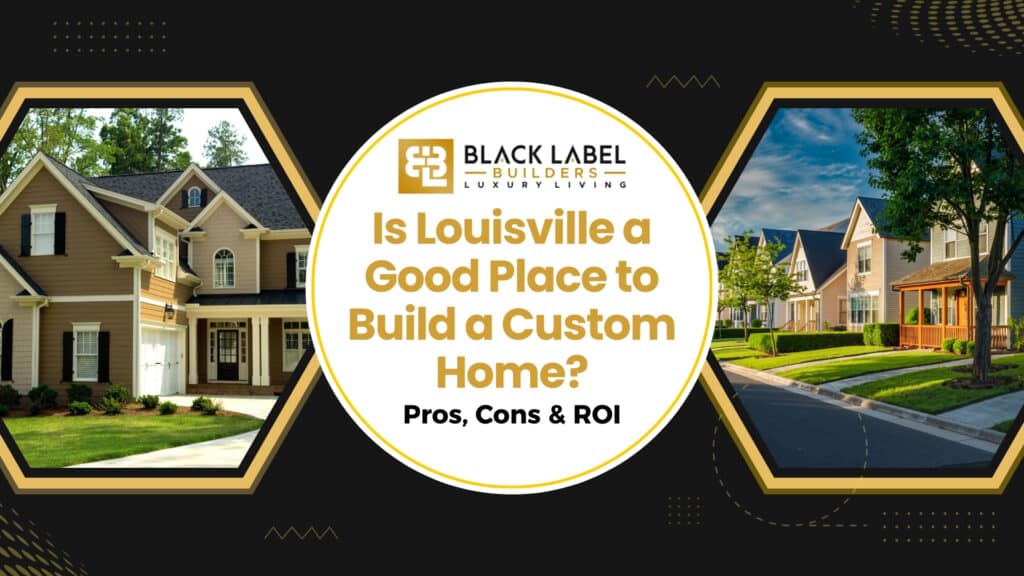
Is Louisville a Good Place to Build a Custom Home? Pros, Cons & ROI
- Andy Simmons
The location of a custom home should be one of the most significant choices in your life. Louisville, Kentucky, is a city that sets itself apart as one worth seeing if you are thinking of it. Louisville is highly advantaged with great local amenities, sound affordability, and vibrant neighborhoods.
Meanwhile, constructing a personal home is a trade-off. In order to maximize on such an opportunity, it is worthwhile to join another reputed builder, such as Black Label Builders, as that will ensure your project is on the right track and offer value.
The Pros: Why Louisville is a Good Place to Build Custom Homes
Louisville is a good choice, which has a number of benefits when it comes to the construction of a custom home. The advantages are some of the following:
Affordability
The median list price in the city is approximately $265,000; thus, the city is cheaper than in other parts of the U. S. metropolitan regions. This enables you to construct an additional or a better refined custom house without excessively spending.
Resilient Housing Market
Both the existing homesteads in greater Louisville saw year-on-year turnover increase by 4.1 per cent in August 2025, with the median selling price reaching 296,000 dollars, a 7.6 per cent rise compared to the previous year. The high demand is an indicator of high confidence in investment in custom homes.
Established Neighborhoods and Infrastructure
Louisville has both historic areas and more recent areas, good educational facilities, parks, and community facilities.
Local Expertise with BLB
Black Label Builders is well-informed about zoning regulations, lot location, and permit difficulties. By teaming with them, you are guaranteed fewer surprises, fewer hassles on the construction, and more peace and functioning of a home over the decades.
These advantages make Louisville not only cheap but also an ideal place to be as a homeowner because of its value, convenience, and long-term quality.
The Cons: What to Watch Out For
Louisville is an excellent location where one can construct a custom home, the location has certain limitations. This realization can help plan and avoid any unwarranted issues.
Increased Prices in Custom Construction
The city is not too costly, but the cost of a custom home is still high. Prices are determined by the size, materials, and complexities of design. Home Builder Digest indicates the average price of constructing a new home in Kentucky will cost between 80 and 135 per square foot.
Market Movements
The housing market in Louisville is mostly stable, although the inventory is subject to change. The housing inventory rose by 34 percent on a yearly basis in June 2025, and this would impact the demand and resale cycle.
Lot and Site Issues
Older areas or infill lots may need further grading, utility connections, or foundation work. This may raise the construction time and costs.
Niche Design
The aspect of niche design can restrict future resale because of its over-specific features. One should strike the right balance between being personal and realistic.
Despite these problems, collaboration with an experienced builder such as Black Label Builders will reduce risks. They assist with site preparation, choice of lot, approvals, realistic budgets, among other things, so that your project does not slip off.
ROI: Will Building a Custom Home in Louisville Pay Off?
Return on investment (ROI) is always a major question. While custom homes are less about short‑term flips and more about long‑term value, the Louisville context is promising. The fact that Louisville ranked No. 3 in the forecast of top housing markets shows upside for appreciation and sale‑market strength.
What that means in practical terms: you’re building in a market where demand is solid, affordability attracts buyers, and the cost basis may be lower than in many large metros. If you build smart, with quality materials, appropriate scale, and good design, you’re setting up a custom home that can deliver both lifestyle enjoyment and strong value.
Smart design decisions do make a difference, even when we assume extra charges that are not obvious. The examples are to get better durability, lower maintenance expenses, and sell better to future buyers, e.g., when you concentrate on structure, insulation, fine roofing, and efficiency of HVAC instead of mere cosmetic improvement measures. BLB emphasises that quality matters, especially for long‑term ownership or resale.
While I cannot guarantee a precise percentage ROI, the combination of affordability, growing market demand, and strong builder expertise makes Louisville a good place for custom homes, provided you execute wisely.
Bottom Line
Yes. Louisville is a very good place to build a custom home. Affordability, constant market demand, and diversity in the neighborhood segments have helped to create promising prospects in terms of both having fun in-house and earning the value increase.
That notwithstanding, winning requires making prudent choices: choosing a lot in an area with great potential, a builder familiar with local factors and competencies, investing in non-permanent structural elements, not to over-customize, and decreasing the number of potential buyers.
Frequently Asked Questions
Build times vary based on size and complexity. For many custom homes in Louisville, expect 9‑18 months from design to completion. It’s crucial to work with a builder who keeps you informed and on schedule.
Yes. Louisville’s median home prices are well below national averages, which means you can build more for your money. According to Realtor.com, Louisville ranks among the top 10 most affordable U.S. metros.
It depends on your priorities. If you want historic charm you might choose neighborhoods close to downtown. If you prefer newer lot development and modern amenities, suburbs may be better. A local builder like BLB can help you pick a lot that fits your lifestyle and build‑plan.
Not necessarily. But if the custom features are too niche, they may limit buyer appeal. It’s best to focus on high‑quality finishes, structural integrity, and functional luxury rather than extremely personalised design that only you love.
Start with the lot cost and site‑preparation (grading, utilities). Then focus on the “core” build costs: foundation, framing, roofing, insulation, HVAC, plumbing, electrical. Once those are solid, you layer in finishes. Good builders will help you prioritise and keep transparency in costs.